If you walked down the boardwalk at Ocean Ridge Hammock Park last October, the Atlantic met the dune with almost no sand in between. Walk it now and there are 200 to 300 feet of open beach where the tide used to sit. That is not a seasonal shift. It is a $9.4 million rearrangement of the shoreline, and it changed the answer to a question residents ask every weekend: which access point is worth using today.
The short version of the thesis: the three beach access points inside a mile of each other, Ocean Ridge Hammock Park, Boynton Beach Oceanfront Park, and the Ocean Ridge Natural Area on Corrine Street, used to be near-substitutes with different parking situations. After this spring's fill, they are three different beaches, and the reason to pick one over the others has changed.
What actually happened between February and April
The Ocean Ridge Shore Protection Project runs on a five-year cycle. The Army Corps of Engineers began the restoration project at Boynton Beach Oceanfront Park in early 2026 to restore the beach from erosion. Work was scheduled for the end of February or beginning of March, and was already slightly behind schedule due to continued erosion.
By late April, the numbers were in. The Army Corps spent $9.4 million to spread over 500,000 cubic yards of sand along 1.1 miles of beach from south of Ocean Avenue to Ocean Inlet Park, with Ocean Ridge Hammock Park to the north of Oceanfront Park also benefiting from the dredging project, and sand transported to the shoreline from an offshore pipeline. The contractor was Weeks Marine, working through the county's Department of Environmental Resources Management. The work was supposed to be completed by May 1 to avoid disturbing turtle nesting, but weather-related delays pushed the timeline back, and actual pumping ended on Monday, April 27, with another 7 to 10 days for equipment removal.
The design life of the project is 5 to 7 years and is intended to restore marine turtle nesting habitat, provide storm protection for public parks and infrastructure, and create recreational space for residents and visitors. Which means: by roughly 2031, the beach in front of your favorite access point will start looking narrow again.
Why the sand is gray, and why it won't stay that way
Residents who saw the newly pumped beach in early April had the same reaction: the color was wrong. It was gray, not the pale bone-tan of the older shoreline. That is not a defect. The gray color comes from organic sediment and is common for beach fill. Sun bleaching and wave action lift the color back toward the tone residents remember. If you have friends visiting in the fall, the photos will look normal again.
One meaningful detail for anyone walking barefoot or bringing children: all material placed on the beach was screened for shell and rock to prevent impacts to nesting marine turtles. The practical read is that this stretch of new sand is unusually clean underfoot compared with a typical Palm Beach County beach the same week after a storm.
The three access points, rewritten
Before the fill, the choice between these access points came down to parking and personality. After the fill, the geography itself is different at each one. Here is the honest resident's map:
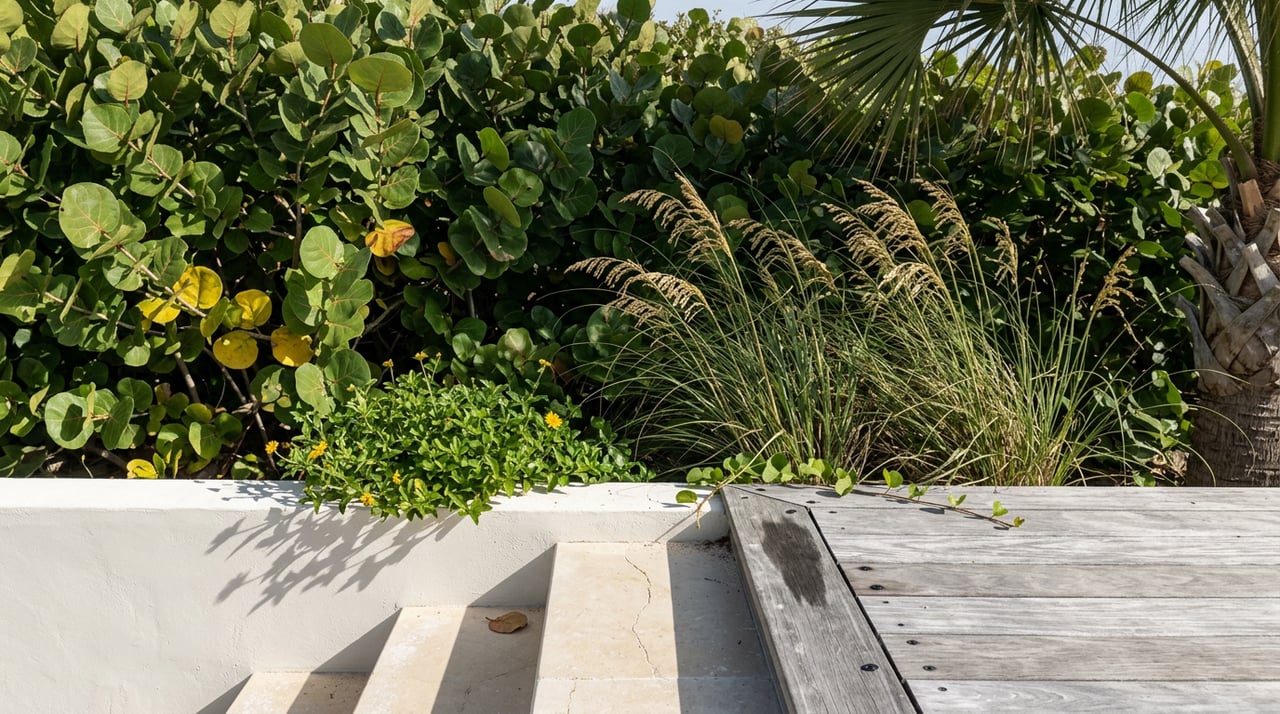
Ocean Ridge Hammock Park (6620 N Ocean Blvd). A small 8.54-acre beach front park buffered from A1A by a thick coastal forest of mainly massive sea grape trees, mixed with gumbo limbo, paradise trees, sabal palms and strangler figs. Amenities are limited to a small parking lot on the west side of A1A, a shower, and the path through the hammock, with no drinking water or restrooms on site, and no lifeguards. After the fill, this is the access point that gained the most usable dry sand relative to its previous footprint. It is also the one where you are still on your own once you cross the dune.
Boynton Beach Oceanfront Park. Open 365 days a year from sunrise to 9 pm, with lifeguards on duty every day from 9 am to 5 pm, staff certified as First Responders or EMTs. This is the full-service option: restrooms, playground, concession, canopy walkways, and lifeguard coverage. The added width here is what visitors will notice first, because the pre-fill footprint was where the crowding problem was worst.
Ocean Ridge Natural Area, Corrine Street. Not a beach. A 1,300-foot accessible trail cuts through the tangle of trees to a central island where there is a boat dock, interpretive kiosk and an observation tower, it's an easy hike for everyone, and Ocean Ridge is reachable by boat, by bike and by foot but not directly by car with no parking lot. Paid public parking is available at Oceanfront Park on A1A just north of Ocean Boulevard, a 10-minute walk away, with no signs on A1A indicating the natural area's presence, so look for Corrine Street and head west, and the entrance is directly ahead.
The point is that these three sit within a mile of one another and do genuinely different things. A resident who used to pick based on parking convenience is now picking based on what a specific morning calls for.
The turtle-season overlap that almost didn't happen
The May 1 completion deadline was not arbitrary. Sea turtle nesting season is from March 1 to October 31, and beachgoers are asked not to disturb their nests. The weather delay pushed pumping into the last week of April, which is inside the window when loggerheads have already begun crawling up the beach. That is why the shell screening protocol mattered so much this year, and it is why the surveying volunteers had extra ground to cover.
For a resident, the practical read on the season is:
- Keep exterior lights dim after dark from now through October. The wider beach means hatchlings have farther to travel from nest to water, and disorientation risk is higher on a broad, flat surface than on a narrow eroded one.
- Never approach or touch a nesting sea turtle, keep your distance, remain quiet, and keep all lights off, including flash photography and cell phones, because touching, prodding or shining lights may cause her to not lay eggs or disturb her and affect how well she covers and camouflages the nest.
- The wooden stakes and orange tape you see cordoning off patches of dry sand are nest markers. Give them room. The people planting them are volunteers.
A resident's summer sequence
If you have not been down to the beach since the equipment left, here is the walk worth taking on a low-humidity morning. It uses the changed geography end to end.
- Park at Oceanfront Park. Annual permits are the honest answer for anyone who lives here. Annual parking permits may be purchased at City Hall at 100 E Ocean Avenue, Monday through Friday, 8 am to 4 pm.
- Walk south along the new sand toward the Ocean Ridge Hammock Park stretch. The width difference between the two access points is easiest to see from the water line looking back at the dune.
- Cross back to A1A and walk south to Corrine Street. There is no sign; the cross street is the only landmark.
- Follow Corrine Street west to the Natural Area boardwalk. Climb the two-story tower. Keep an eye out for ospreys, little blue herons, night herons, ibis, egrets, cardinals and mockingbirds, look for warblers and other migratory birds in the cooler months, and if you're lucky you might catch a glimpse of a manatee.
- Return the same way. Total distance is under two miles round trip, and the shade under the hammock canopy on the return leg is why you do it in this direction rather than the reverse.
Parking friction, honestly
The Hammock Park lot has always been small, and the ParkMobile setup is where most first-time visits go wrong. Set up the account before you leave the house rather than at the trailhead where the sea grape canopy interferes with cell signal.
At Oceanfront Park, daily paid parking runs through the ParkMobile app at $2.50 hourly, which makes the $65 annual permit break even in about 26 hours of use across the year.
What to watch through October
A few things worth tracking as the summer plays out:
- The dune profile. The Corps rebuilt both the beach and the dune. Watch how the new dune line holds through the first meaningful summer storm system. That will tell you more about the seven-year projection than any press release.
- Nesting counts. The Ocean Ridge stretch feeds into county-wide totals that get reported in the fall. Palm Beach County consistently ranks among the highest-density loggerhead nesting shorelines in the world, and how this year's fresh sand performs matters to future funding cycles.
- Neighboring events. If you want to combine a beach morning with something in walking distance, the Boynton Beach Night Market runs Friday and Saturday, July 24 and 25, 2026, from 5 pm to 11 pm at Centennial Park and Amphitheater at 120 E. Ocean Avenue, with free admission.
The wider beach is not permanent. Enjoy it while the geography is still on your side.
If you are thinking about how a shift like this changes what your Ocean Ridge property offers a future buyer, or you simply want a local read on the block, Judith Randon Realty is happy to talk. Schedule a Free Home Valuation and Consultation whenever the timing works.